


In recent months, I’ve written on LinkedIn about Mitch McConnell getting more paid medical leave than a person who had a baby. About how the news of the Cornell 57 changed my interactions at a conference. About Pride Month, about mansplaining, and about a million other things. I am very happy to work with people who have different politics from me, but I’m done keeping mine a secret. My politics are tied to my values, and my values shape how I conduct business. I think probably anyone with strong political convictions would say the same thing, regardless of which side of the aisle they are on. That’s that.
Every time I post something even remotely political (literally every time) on LinkedIn, I get dozens of messages from people who say some version of “thank you for saying it, because I couldn’t.”
Couldn’t!!
I believe them! I don’t think they’re chickening out. I think, in the current political and business environment, some people think posting “Happy Pride!” will be viewed as political and result in retaliation. If you’re trans, or an immigrant, or you work for a company whose owner writes big checks to the other side, you may be risking a job, a client, relationships, or the feeling of being safe when you show up for work.
I think lots more people (I bet many reading this) think politics doesn’t have a place on LinkedIn or at work (they may be right! More on that later).
For me, the math on what speaking up will cost me is mostly followers. I lose dozens and sometimes hundreds every time I post about politics. I’m sure it’s cost me some business. But I think it’s probably won me some too. So in the end, it just isn’t as hard for me to do it as it is for some others.
One thing before I go further. My politics are pretty obvious. If you’ve been reading me for a while, you already know where I land. But if you disagree with me, and your opinions are totally different from mine, I think everything in this post is still true for you. And I don’t hate you. Let’s talk about why you believe what you believe and how that impacts how you show up at work!
Listen, you may have heard the midterms are Tuesday.
So let’s talk about whether to speak up if you have a strong opinion about how those midterms should go and how leaders can prepare for half of their workforce to be very sad on Wednesday, no matter what happens.
I think I’ve seen this film before . . .
Consumer brands have been living with when and how to take political stances for years, and we’ve all watched how it plays out.
Bud Light lost its spot as America’s top beer over one sponsored post with a trans influencer.
Disney opposed Florida’s “Don’t Say Gay” bill and ended up in a years-long fight with the governor.
Nike put Colin Kaepernick in an ad and a lot of younger customers loved them more for it.
Target got it from both directions. The right came for them over Pride merchandise in 2023. Then they rolled back their DEI commitments in 2025 and the left organized a boycott that dragged on for months, and the CEO eventually stepped down. But here’s what people leave out when they tell that story: Target’s stock has climbed back about 30% this year. The outrage cycle moves on. People still need paper towels.
B2B was supposed to be immune
B2B was supposed to be immune to all of this. Our buyers are companies, not individuals. Our contracts run for years. Nobody rips out their CRM because they didn’t like who the CEO had dinner with.
And that’s true, if you’re Salesforce. Marc Benioff spent years as tech’s loudest progressive CEO. Then last fall he told the New York Times he fully supported Trump and wanted the National Guard patrolling San Francisco, and apologized within days. As far as I can tell, nobody canceled a contract. When your product runs half the Fortune 500, your CEO’s opinions are a news story, not a churn risk.
Most of you are not Salesforce. If you run a 50-person agency or a Series A-C SaaS company, you are the brand. Your LinkedIn is the company’s marketing. Your opinions are the company’s opinions, whether you meant them to be or not. Your clients can replace you in a quarter, and some of them will if they decide they don’t like you.
I know a consultant who posted something anti-Trump on her personal Instagram, not her work account. Someone called every one of her clients to harass them about working with her. She lost half a million in business over it.
And before anyone emails me: yes, this cuts both ways. I know founders who are sure that if they say the wrong thing from the other direction, the “woke police” will come for them just as hard, and their business will take the hit. They’re not imagining it. Brendan Eich stepped down as Mozilla’s CEO in 2014, days after it became public that he’d donated to the campaign against same-sex marriage. You risk your opinions becoming your company’s opinions, no matter which way they lean.
If you have payroll to make, silence can look like the responsible thing. I get it. I’m not going to call anyone a coward for being careful when forty or a hundred or a thousand families are depending on them.
Staying quiet can also cost you something
But something has shifted this year, and I don’t think most leaders have caught up to it.
Staying quiet also has a cost. Corporate political spending in these midterms has hit $646 million, about 40%more than the entire 2024 cycle, which was the previous record. A lot of that money went toward staying on the right side of power. And now that Congress could change hands, the Wall Street Journal editorial page, which is not exactly a hotbed of resistance, is telling corporate America to lawyer up.
Keeping your head down was never neutral. It was a bet. Some of those bets are about to come due.
“Can we please keep work and politics separate?”
I know some of you are already rolling your eyes, if you’ve even read this far. Can we please just keep work and politics separate?
I want to take that seriously. It is true that your company is not your personal soapbox. Your employees didn’t sign up for your opinions, and neither did your clients. You’re the steward of something bigger than your feelings. Your clients signed up for an AI-native, cross-functional, agentic, full-funnel, outcome-obsessed revenue orchestration layer that “meets them where they are.” Not your thoughts on the Supreme Court.
There is a real difference between using your company to tell people how to vote and using your company to make sure they can.
Almost everything I’m about to suggest is the second kind. Despite my own habit of sharing my personal politics, you don’t have to if it doesn’t feel right to you.
But.
I also don’t buy that work and politics were ever separate. Politics decides who can vote, who gets healthcare, who can start a business, who gets funded, and who gets audited. When rights get rolled back, or a law targets a specific group of people, it shows up at work, in morale, in retention, and in who talks in meetings and who goes quiet.
When most people say “keep politics out of work,” what they mean is “keep conflict out of work.” The conflict is already here. It just isn’t happening to them.
I’ve heard this called the neutrality tax, which is what your silence costs. The people who pay it are the ones on your team who can least afford it. They are the ones thanking me privately because saying it in the comments would mean outing themselves, or their kid, to everyone they work with.
So should you say something?
Look, I know this is a sensitive topic, and there are people reading this who I really admire professionally who have different political views than me. This might piss you off, but here’s where I landed.
If your political views are expansive and inclusive, and sharing them would help the people around you feel safer at work, I want to encourage you to speak up. If your views would make people on your team feel like they need to hide, or feel ashamed of who they are, then no. I’m not going to encourage you to speak up.
If you’re on the fence, here are the questions I’d ask myself before being public with your political views:
Who on my team is most affected by this issue? After they read it, will they feel safer, or more like they need to hide?
Am I talking about an issue, or attacking a person? “We believe in equality under the law” lands differently than a dunk on a candidate.
Would I say this to the face of someone it’s about? If not, it’s probably not ready.
Have I considered the consequences? Can my business survive losing the clients who disagree? (Some will leave. Some new ones may show up.)
Am I ready to be called an idiot and an asshole? Because I promise you, someone will.
What to do before Tuesday
Okay. I’m getting rambly. This is something I think A LOT about.
Let’s get practical, because Tuesday is close.
You don’t need a manifesto. Most of you don’t have a PAC or an ad budget to aim at anything, and you don’t need one. Here’s what a 20- or 200-person company can do before Tuesday, regardless of your individual political beliefs.
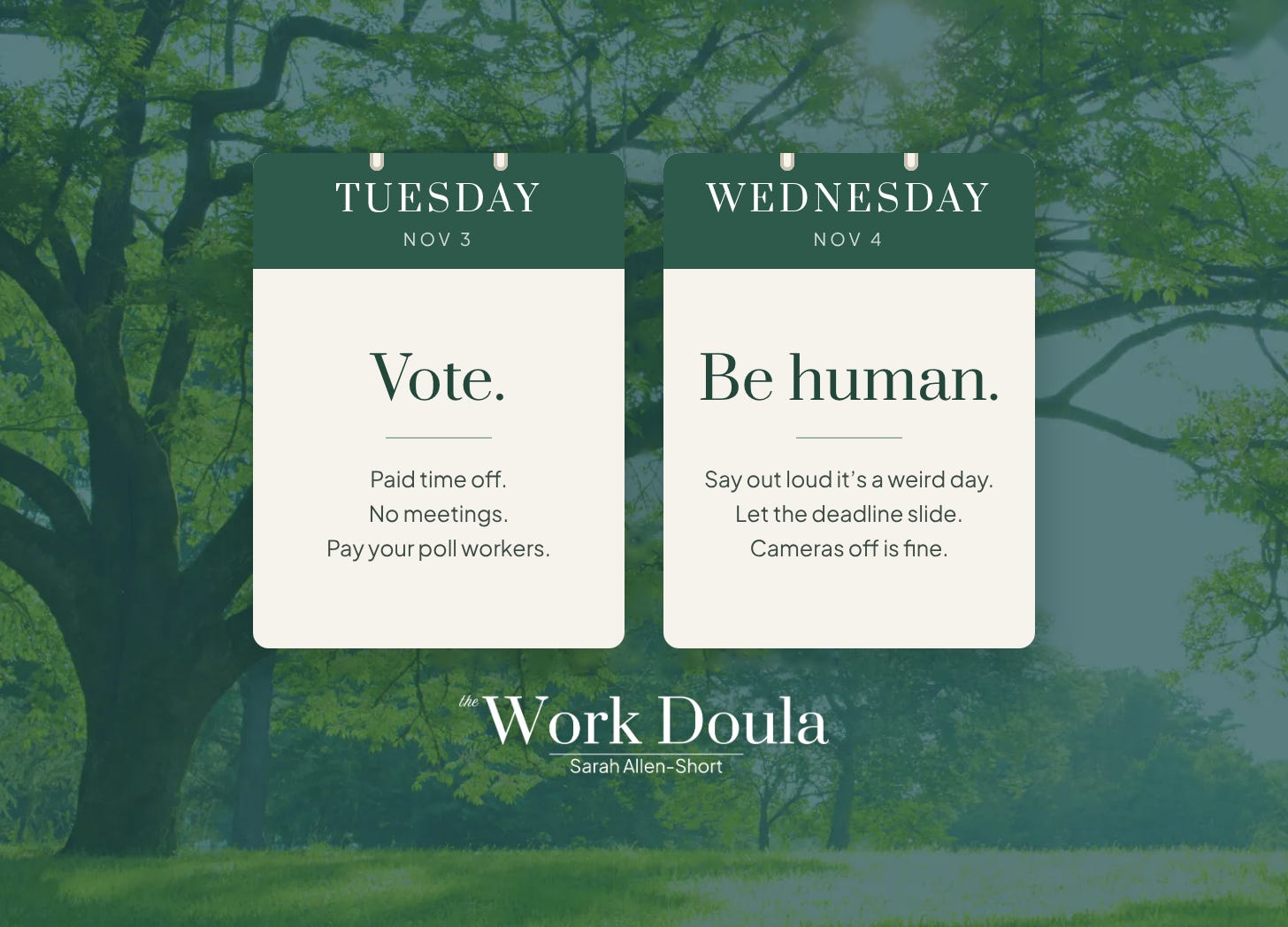
Give people paid time to vote, and put it in writing. About half of U.S. states already require employers to give at least a few hours off to vote. Check your state. You may already owe it. Do this even if your team is virtual!
Make Tuesday a no-meetings day if you can swing it.
Pay your poll workers. If someone on your team wants to work the polls, pay them for the day.
Don’t do it alone. Time to Vote is a nonpartisan business coalition that has been doing this for years. It’s now part of the Civic Alliance, which has more than 1,300 member companies.
Send one short note. Vote: here’s how to find your polling place; take the time. Not who to vote for. Just that.
Then there’s Wednesday
Whatever happens Tuesday night, you’re going to walk into Wednesday with people who are grieving and people who are elated, often in the same Zoom. Some races won’t be called yet. Some people won’t have slept. You don’t need a hot take. But please don’t pretend it’s a normal Wednesday.
This is the part I care about most. Here’s your job on Wednesday:
Name it. Say out loud that it’s a complicated day. You don’t have to say why.
Move what can move. If a deadline can slip, let it slip.
Let people be quiet. Cameras off is fine. So is skipping standup.
Don’t let anyone get bullied in your Slack, in either direction.
*******
One of my core values has always been standing up to bullies. I’ve never found a version of silence that doesn’t feel, at least a little, like letting them win.
I don’t know whether B2B buyers will reward or punish leaders for where they stood this year. I don’t think anyone does yet.
But I keep thinking about the people in my DMs whose work feels harder and scarier and more exhausting because of what’s happening in the world, and who can’t say so anywhere their boss or their clients might see. They’re not asking me to fix anything. Mostly they just want someone to know.
Somebody on your team is feeling that right now. Would they tell you?