


Earlier this year, I was in one of those stretches where everything was due at once, and I felt like I was drowning. A colleague could tell I was overwhelmed, and they asked how they could help.
It barely registered. It felt like a nice thing a nice person says to be nice, but (and I know this sounds awful) it’s actually pretty useless.
In order to take them up on their offer, I’d have to figure out what they could take off my plate, decide whether explaining it was faster than just doing it myself (it usually isn’t), explain it, and then check back to make sure it actually got done to my standards.
I mean, I’m not mad at them. They were genuine and kind, and I’m sure if I’d come up with something, they would have cheerfully done it.
Also, just so you know, I say it all the time too. Just the other day, I was talking to a CEO client who is completely underwater. I said, “Just let me know how I can help.” She murmured words of appreciation. She said she had it under control. I left the call feeling like a nice person who’d made a nice offer, and she left the call with the exact same to-do list.
What I should have said was, “I’m taking the investor update. You’ll have a draft Thursday.” Better yet, I should have just done it.
Here’s the thing about her, though. She’s a good delegator. It’s a skill she's purposely and intentionally cultivated over the last decade of her career through coaching and practice. Her team is strong, and they get shit done. But she’s still the one lying awake at 2 a.m.
Most experienced leaders delegate the doing, but they keep the planning, the worrying, the staying up all night thinking about it, and then the thinking about it some more in the shower.
Which is why, when every exec coach (hi), board member, and business book tells you to just “delegate more,” it honestly can be kind of shitty, naive advice.
I’ve been thinking about this a lot lately as I’ve been that coach tempted to give that shitty advice to overwhelmed leaders, especially in conversations with CEOs and other C-suite leaders. Is this just part of the job? Is carrying all this shit around in your head simply what you signed up for when you took the top seat? Can you actually delegate the mental load, and even if you can, should you?

Yep, we’re talking about “mental load”
If you’ve been anywhere near a conversation about marriage or parenting in the last ten years, you know the term “mental load.” You may relate to it deeply, and you may feel it’s been weaponized against you. But if you’re not familiar with the concept, you should be. Here’s the short version.
There are the tasks of running a life. Make the dentist appointment. Sign the permission slip. Buy your mother-in-law a birthday present she will probably return. Buy your kid cleats. Anyone can do those tasks.
But REMEMBERING all of it with context? That’s a whole other job (a whole ‘nother, as we say here in the South). Knowing the dentist appointment has to happen before the insurance resets, and that the permission slip is due Thursday and is probably crumpled up under a granola bar wrapper at the bottom of the backpack. Knowing where to buy gently used cleats, because it doesn’t make sense to buy new ones when your kid is only going to wear them for one season before outgrowing them, and knowing it needs to be done before the first practice this Thursday, knowing what size they are now and that they would really prefer pink if possible, and that the place that sells them closes at 5 p.m. As a new empty nester, the days of this kind of mental load at home are mostly over for me, but I remember them so well, and I’m exhausted just writing that paragraph.
Figuring out who should do what, and in what order, and then checking that it actually got done? That’s the mental load.
A sociologist named Allison Daminger calls it “cognitive labor” and breaks it into four pieces:
Anticipating what needs to happen
Figuring out the options
Deciding
Keeping an eye on whether it got done
Notice that DOING the work isn’t on this list. That’s the practical labor rather than cognitive labor.
Eve Rodsky, who wrote Fair Play, makes it even simpler:
Conception is noticing the thing needs to happen
Planning is the how and the when and the who
Execution is somebody actually doing it
Plenty of households have one partner or parent who is genuinely, cheerfully willing to do anything they’re asked. But they still have to be asked. That person ends up running around doing, doing, doing without understanding why their contribution isn’t more appreciated, while the person carrying the cognitive load doesn’t feel like they’re getting the help they need. Both people feel shitty and undervalued.
I’m seeing the same dynamic happening at work. (This post actually started as a LI post about how AI agents are like a partner who needs direction on every little thing, and morphed into a broader concept about delegation and mental load.)
When you delegate but don’t actually hand it off
Rodsky’s three parts translate almost perfectly to running a company, a division, a product, or a discipline like marketing or sales:
Execution covers things like building decks, running QBRs, organizing an SKO, building out the webinar campaign. Somebody tracks it, and your team is probably very good at it.
Planning is a little harder to see. Deciding who should be involved in the exe search, working out the narrative of the board meeting, figuring out how to sequence launch campaigns all usually fall to strategic leadership.
Conception and anticipation are almost invisible. It’s sensing that a board member has gone silent in a way that usually means a big (and likely unpleasant) conversation is coming your way. It’s realizing the strategy everyone agreed to in January doesn’t make sense anymore, or that your best leader has been short in Slack all week and is either drowning or very pissed of about something.
Most companies do pretty well at managing execution with OKRs and KPIs and standups and project trackers and a Slack channel for every one of them.
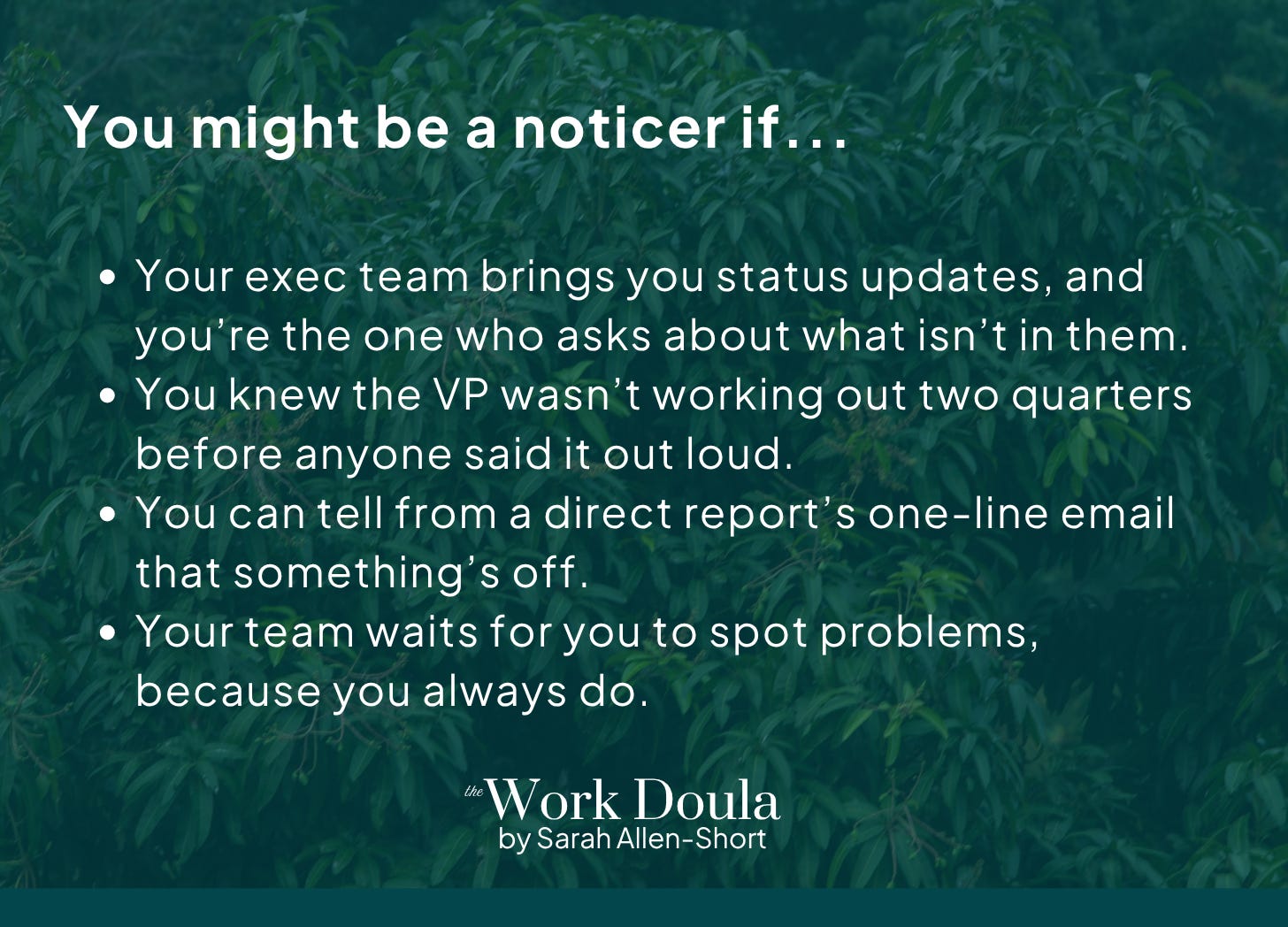
Think about what your team brings you every week: status, updates, what got done. It’s great for figuring out activity, but less great for figuring out what isn’t on the list that should be.
You’ve delegated plenty. You just haven’t delegated the noticing (is that even possible?), so all of it still rolls uphill to you.
It also rolls downhill. Below you, a handful of people usually do the same thing for their corner of the business.
Your Director of Demand Gen has noticed that the new ad campaign achieved MQL goals, but also took it upon herself to check whether sales is working the leads, and they aren’t. She‘s not sure she should spend all her webinar budget because it isn’t delivering, but knows if she doesn’t, she’ll lose it. She’s also worried the CFO is going to rip apart her attribution numbers at the next ELT meeting. And she doesn’t have the power or authority to fix any of it.
Your VP of North American Sales knows four of the deals committed to close next quarter are from a rep with a reputation for a fuzzy definition of “committed.” She’s thinking about how the top rep has been complaining about comp structure and worries they might be taking recruiter calls. She’s also knows the champion on your biggest renewal is looking to leave the company, but can’t tell CS yet.
Your VP of Product Marketing has noticed that last IPM used a deck that was supposed to be sunsetted 6 months ago. She engineering isn’t prioritizing the feature that the launch date depends on. And she’s starting to suspect that pricing is an unspoken reason the last few deals have failed to progress.
The mental load of being the only one
There’s another version of this that I wasn’t even going to include in this article until I read this post by LeeRon Yahalomi just yesterday, and I wanted to make sure to include it.
If you’re the only woman in the room, or the only brown person, or the only queer person, or the first of anything, you have a mental load nobody else at the table can see. Every time you speak up, part of your brain is running a second calculation. You’re ALWAYS deciding whether or not to say something, to call someone out, to be the squeaky wheel, to be the one to educate the rest of the room on why whatever is happening is problematic. You’re also probably aware that you’re not just representing yourself. If you get something wrong, it’s not just your mistake. It becomes evidence about women, or immigrants, or whatever else people may have decided you stand for.
So you over-prepare, and you reread the email 3x for tone before you hit send, and you’re constantly figuring out which hill is worth dying on today and which one gets you labeled “difficult” for the next year.
It feels important when we talk about mental load to talk about this very specific kind of cognitive labor as well.
If you’re running a company, there’s a good chance someone on your exec team is dealing with it right now. It might also be you.
Your best noticer is a flight risk
A quick word on burnout. People can work a ridiculous number of hours on things they choose. What exhausts people is the anticipation, the juggling, and yes, the mental load. Your default noticer looks like your highest performer right up until she’s updating her LinkedIn on the down low and putting feelers out to her network.
And if the person doing all the noticing is you, you might notice it as a shorter fuse, slower decisions, or increased micromanagement. You might see it in a team that is less proactive than they should be, because they know you’re hyper competently on top of everrrrything.
What handing it off actually looks like
At home, Rodsky’s fix is to hand off the outcome including the conception, the planning, and the execution, including noticing it needs doing.
The same thing holds true at work.
For you as a leader:
Give your lieutenants whole outcomes. If you tell someone to own demand gen, they have to do the noticing. If you tell them to get you the MQLs, then you’re still the noticer. Be mindful of checking constantly on execution once you’ve handed it off. Yes, this requires a talented team you can really trust.
Ask what they anticipated instead of (or in addition to) what they accomplished. In your one-on-ones, ask direct reports what they saw coming, and what they rethought. Strong strategic thinkers will have answers to those questions.
Hire an offical noticer if you can. A chief of staff, COO, or great EA can own the noticing if you hire them for that and tell them (and everyone else) it’s their job.
Promote the noticers, and make sure they and the rest of the team know that’s part of why they’re getting elevated. Put anticipation in exec job descriptions and in reviews.
For the people (above or below you) who you are trying to help:
Take something instead of offering. Stop saying “my door is always open,” “Let me know if I can help” or “Flag anything you need me for.” Jump in and take something specific off their plate, even if it’s just a draft.
Watch for “onlies” and “firsts”. If you have the only woman on your exec team, or the first person from their background in a role, be careful not to make them the default spokesperson for their larger group. Look for signs that they may be doing the culture work on top of the actual work. (Yep, that’s more noticing for you!)
Identify your top-performing noticers. As you’re thinking about bringing on a new piece of tech or doing a re-org, can you name the biggest existing noticers on your team? If you can’t, it’s probably you. If you can, make sure you get their help in whatever you’re bringing on to alleviate stress.
Join me for the last “Work Pause” of 2026
One more thing. If reading this made you realize how tiring it is to be the noticer, I’m hosting something for exactly that.
The Year-End Work Pause: The Unofficial Review is a one-hour guided writing session on Zoom on Friday, December 4 from 12-1 ET.
We’ll look back at 2026 as it actually went (not the version in your year-end deck), what it cost you, and what you want to take into 2027.
There are no resolutions, vision boards, or icebreakers. I give you a prompt, you write, and sharing is completely optional. It’s capped at 10 people, so it stays small.
Grab a spot here. Tickets are $25, and if that’s a barrier, message me on LinkedIn or email me at sarah@sasadvisorygroup.com and I’ll send you a code to come for free.
And if you’d rather talk it through one-on-one: I’m a GTM advisor and executive coach, and this is exactly the kind of thing I help leaders untangle. If my approach sounds like a good fit, I’d love to chat.
SUCH AN IMPORTANT CONVERSATION! I have been very aware of the mental load issue at home, but it never occurred to me that it applies at work too. I appreciate you including the piece about "being the only one" - I have definitely been in that role as well and it's nonstop as well as exhausting. Thank you for this!